

I am about to embark on my twenty-third trip to Poland. This is a special journey because it involves so many elements. Elements of deep loyalty to old friends in troubled times, primal connections to fellow Jews, and a duty not to despair have marked my journeys to Poland. I am traveling with my son, […]

Tongue and the Megaphone

Thoughts on Parashat Tazria-Metzora
Death and life are in the power of the tongue, and those who love it will eat its fruit.
(Proverbs 18:21)
Our parasha for this week talks extensively about some form of a skin disease. Some scholars call it now “scale disease,” but for centuries, if not millenia, people thought that the Torah was talking about leprosy. But this is a misnomer. The famous Greek physician, Hippocrates, grouped together a bunch of different skin diseases under a single Greek name “lepra”. Then, in the 3rd century BCE our Jewish scholars, probably for lack of a better word, used the name “lepra” in the first, Greek translation of the Hebrew Bible, known as the Septuagint. Since then, people all over the world have thought the Bible was talking about leprosy.
Poles and Jews: A Call for Myth Reconstruction
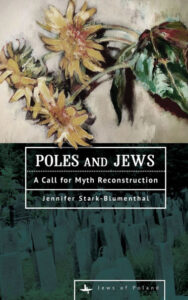
Independent researcher Jennifer Stark-Blumenthal will present Poles and Jews: A Call for Myth Reconstruction, an expansive and engaging investigation into centuries of changing Polish-Jewish relations. With forthright honesty the author calls on Poles and Jews to recognize and challenge the “myths” each tells about the other and themselves.
Rokhl Auerbach, the Yiddish Shmoozers, and Jewish Cultural Resistance to Regime Change in America
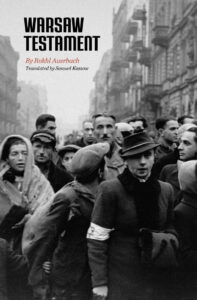
Among a welcome cascade of Yiddish books newly translated into English, Warsaw Testament calls out to be read now. Writer Rokhl Auerbach compiled and structured the bulk of the book’s narrative in Tel Aviv in 1973, drawing on her earlier eyewitness notes on Jewish suffering and resistance under Nazi occupation two decades earlier. In Tel Aviv, she wrote:
“Driven by an uncontrollable impulse, I wrote in secrecy and solitude. . . . In the autumn of 1943 and during the winter of 1943-44, working between midnight and 5 a.m., I wrote two works: They Called it Resettlement, on the Great Deportation of 1942, and what became, as I kept adding more material, an early draft of this book. In the daytime I would hide my notebooks at the bottom of a drawer and cover them with the apples, pears, dark flour, and barley cereal bought with the ration cards. (p. xlii).”
CLICK TITLE TO CONTINUE READING
- « Previous Page
- 1
- …
- 9
- 10
- 11
- 12
- 13
- …
- 222
- Next Page »