• ABOUT
    • WHAT WE DO
      • OUR BROCHURE
      • CLERGY CABINET BLOG
      • CONGREGATIONAL HAPPENINGS
      • UKRAINE
        • JANUSZ KORSZAK CHILDCARE CENTER SUPPORTING SPYNKA
        • IN THE MATTER OF UKRAINE – WEBINAR
        • SUITCASES OF LOVE: CHAPTER 1
        • SUITCASES OF LOVE: CHAPTER 2
        • UKRAINIAN REFUGEE AID UPDATES
        • INTERIM PLANS AND GUIDING PRINCIPLES
        • SPECIAL REPORT UKRAINIAN REFUGEE RELIEF AND BEIT POLSKA REDEVELOPMENT
      • EVENTS
        • MORE EVENTS
        • CONCERTS
      • INITIATIVES
      • VISITING POLAND
      • HOLIDAYS
      • NARRATIVES
        • MORE NARRATIVES ON RABBI BELIAK’S BLOG
      • BEIT
        • BEIT WARSZAWA
        • BEIT TROJMIASTO
        • BEIT CENTRUM KI TOV
      • LIFECYCLE EVENTS
      • PAST TOURS OF POLAND
      • STEP-BY-STEP
        • Turning Points in Jewish History; The First Class
  • WEBSITE
  • WEBINARS
    • Turning Points in Jewish History
  • NEWSLETTER ARCHIVE
  • ENGLISH SERMONS
  • POLISH SERMONS
  • CONTACT
  • DONATE

FJRP Blog

Friends of Jewish Renewal in Poland

Friends of Jewish Renewal in Poland logo

Poland Travel Log by Andrea White

By Guest Author 04/13/2025 1 Comment Filed Under: Poland Travel Log, Visiting Poland

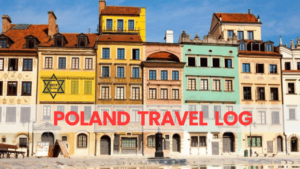
Poland Travel Log__graphic ad

POLAND 2023

Why Poland?

Scanning the travel brochures that arrive in the mail or the Sunday Travel sections in our newspapers, we noticed that few itineraries include Poland. Perhaps Krakow, perhaps Warsaw, perhaps the German death camps, but nothing very thorough. So we thought we would like to look more carefully at the country that produced Nicolaus Copernicus, Fryderyk Chopin, the three Singer siblings, Arthur Schopenhauer and Günter Grass (both born in Danzig, Germany/now Gdansk, Poland), Pope John Paul II, Leck Wałęsa, Ignacy Paderewski, Isaac Stern, Joseph Conrad , Maria Salomea Sklodowska (Marie Curie), Czeslaw Milosz- to name only the most obvious – and decide for ourselves. The first thing we had to get our heads around was that Poland is a relatively new country, having only lately emerged from totalitarianism. World War II only ended for Poland in 1989; after six years of the protracted horrors of the Nazi German occupation and then over forty years of Soviet Russian control, the country, newly democratized and independent, occupied once again the center of Europe’s map, stretching from the Baltic Sea to the Czech Republic.

Overcoming Spiritual Impediments

By Menachem Mirski PhD 04/11/2025 Leave a Comment Filed Under: Sermons

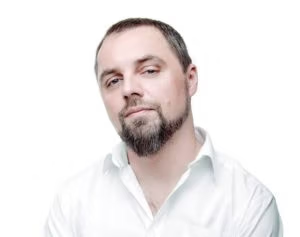
Photo of Rabbi Menachem Mirski

Thoughts on Pesach 5785

There are different types of freedom: freedom of speech, freedom of belief, freedom of movement, economic freedom etc. There are at least 40 of them. On a more general, philosophical level, we divide freedom into freedom from and freedom to. ‘Freedom from’ entails the right to be free from interference or domination, and focuses on protection of our innate rights and emotional safety. It lays the groundwork of a society where citizens can live without fear of oppression and can thrive as a community. “Freedom to”, generally speaking, refers to the liberty to conduct desired actions without restriction. It is the capacity to make choices that are yours alone, independent of external influences or pressures. The borders of all kinds of freedoms are defined by law, freedoms of different individuals and entities in the society, as well as the means one has in his or her possession.

The “Small” and the “Big” Transgressions

By Menachem Mirski PhD 04/04/2025 Leave a Comment Filed Under: Sermons

Photo of Rabbi Menachem Mirski

Thoughts on Parashat Vayikra 5785

Moshe was very bothered about the sin he committed, namely, that he didn’t wash his hands
and didn’t say a blessing before he ate. So he decided to see his rabbi, to confess the sin
hoping that it would make him feel better: “Rabbi, last week I didn’t wash my hands before I
ate, I didn’t say the blessing, and I am very upset about it.” – “Well, that’s not the most
severe sin in the world”, said the rabbi, “just remember to do it next time and every time
before you eat. But, out of pure curiosity, why did you not say the blessing?” asked the rabbi.
“Well the food itself wasn’t kosher, so I didn’t think it was appropriate” – “You ate non kosher
food? Hmmm… this is much more serious, Moshe.

Dr. Samuel Kassow’s Translation and Framing of Rokhl Auerbach’s Warsaw Testament

By Rabbi Haim Dov Beliak 04/04/2025 Leave a Comment Filed Under: Freighted Legacies

Rokhl Auerbach’s many careers as a writer, philosopher, historian, Yiddish language advocate, and survivor are eclipsed by the outsized role she played in preserving the record of the Holocaust. In the Warsaw

Ghetto, Emmanuel Ringelblum conceived and organized over sixty people for his Oneg Shabbat archive. Auerbach worked the Ghetto’s soup kitchen and chronicled the struggle to maintain life. Auerbach was one of three people that knew of the buried archive, She remained in Poland to work on those materials when they were discovered and to collect other testimonies.

  • « Previous Page
  • 1
  • …
  • 10
  • 11
  • 12
  • 13
  • 14
  • …
  • 222
  • Next Page »
  • Facebook
  • RSS
  • YouTube
DONATE TO OUR GENERAL FUND HERE
SUBSCRIBE TO OUR YOUTUBE CHANNEL
EUPJ_logo

Categories

Archives

Copyright © 2026· Friends of Jewish Renewal in Poland