• ABOUT
    • WHAT WE DO
      • OUR BROCHURE
      • CLERGY CABINET BLOG
      • CONGREGATIONAL HAPPENINGS
      • UKRAINE
        • JANUSZ KORSZAK CHILDCARE CENTER SUPPORTING SPYNKA
        • IN THE MATTER OF UKRAINE – WEBINAR
        • SUITCASES OF LOVE: CHAPTER 1
        • SUITCASES OF LOVE: CHAPTER 2
        • UKRAINIAN REFUGEE AID UPDATES
        • INTERIM PLANS AND GUIDING PRINCIPLES
        • SPECIAL REPORT UKRAINIAN REFUGEE RELIEF AND BEIT POLSKA REDEVELOPMENT
      • EVENTS
        • MORE EVENTS
        • CONCERTS
      • INITIATIVES
      • VISITING POLAND
      • HOLIDAYS
      • NARRATIVES
        • MORE NARRATIVES ON RABBI BELIAK’S BLOG
      • BEIT
        • BEIT WARSZAWA
        • BEIT TROJMIASTO
        • BEIT CENTRUM KI TOV
      • LIFECYCLE EVENTS
      • PAST TOURS OF POLAND
      • STEP-BY-STEP
        • Turning Points in Jewish History; The First Class
  • WEBSITE
  • WEBINARS
    • Turning Points in Jewish History
  • NEWSLETTER ARCHIVE
  • ENGLISH SERMONS
  • POLISH SERMONS
  • CONTACT
  • DONATE

FJRP Blog

Friends of Jewish Renewal in Poland

Friends of Jewish Renewal in Poland logo

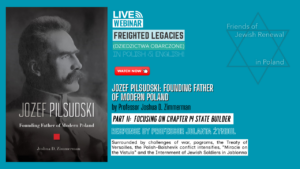
Jozef Pilsudski: Founding Father of Modern Poland by Professor Joshua D. Zimmerman

By Rabbi Haim Dov Beliak 01/27/2026 Leave a Comment Filed Under: Freighted Legacies

02-15-26_Jozef Pilsudski Founding Father of Modern Poland by Professor Joshua D. Zimmerman__WATCH NOW_GRAPHIC AD

Part II: Focusing on Chapter 14 State Builder

WEBINAR 2/15/26 – The story of the enigmatic Jozef Pilsudski, the founding father of modern Poland: a brilliant military leader and high-minded statesman who betrayed his own democratic vision by seizing power in a military coup.

In the story of modern Poland, no one stands taller than Jozef Pilsudski. From the age of sixteen he devoted his life to reestablishing the Polish state that had ceased to exist in 1795. Ahead of World War I, he created a clandestine military corps to fight Russia, which held most Polish territory. After the war, his dream of an independent Poland realized, he took the helm of its newly democratic political order. When he died in 1935, he was buried alongside Polish kings.[…]

Pharaoh’s Grip and Modern Chains: Redefining Personal Freedom

By Menachem Mirski PhD 01/23/2026 Leave a Comment Filed Under: Sermons

Photo of Rabbi Menachem Mirski

Thoughts on Parashat Bo 5786

The wine problem

Moshe says: I don’t have a drinking problem.

His friend, Shmuel, says: You just finished the entire bottle yourself!

Moshe answers: Yes, but I shared the guilt with my mother.

Yes, it’s possible that Pharaoh who had a hardened heart problem shared his guilt with his mother. But even if he had any guilt, sharing it, let alone putting the entire blame on someone, doesn’t help. What helps is making real change and being firm about it. But Pharaoh most likely didn’t like the word “change”, especially if it was to be used in reference to any of his traits or decisions.[…]

The Fragile Gift of Free Will

By Menachem Mirski PhD 01/16/2026 Leave a Comment Filed Under: Sermons

Photo of Rabbi Menachem Mirski

Thoughts on Parashat Vaera

In our parasha for this week (Exodus 6:2–9:35), we encounter one of the Torah’s most profound explorations of human agency amid divine intervention. As God unleashes the first plagues upon Egypt to liberate the Israelites from bondage, Pharaoh’s response reveals a chilling dynamic: the hardening of his heart. The text alternates between Pharaoh hardening his own heart and God doing so, raising timeless questions about free will. Does divine involvement negate human choice? Or does it illuminate the consequences of our repeated decisions? Drawing from the wisdom of Rabbi Jonathan Sacks, of blessed memory, in his Covenant & Conversation essays on this parasha—such as “Freewill” and “The Weighing of the Heart”—we can uncover a powerful message: while from the social and political perspective individual freedom is or should be a fundamental human right, this right does not guarantee it will become a reality. Our individual free will is a delicate capacity that can erode through our own actions, turning us into prisoners of our choices.[…]

Love, Friendship, and Longevity: How Relationships Add Years to Our Lives

By Menachem Mirski PhD 01/02/2026 Leave a Comment Filed Under: Sermons

Love, Friendship, and Longevity_IMG_5387

Thoughts on Parashat Vayechi 5786

Today, I’m going to talk about something that is as timeless as the Torah itself – how nurturing our relationships, from marriages to friendships, can literally add years to our lives. Arguing with God, doctors, and relatives also can add years to our lives, and definitely keeps our mind sharp but that’s a topic for another drash. Today I will focus on relationships.

In Parashat Vayechi, the Book of Bereishit draws to a close with Yaakov on his deathbed at age 147, gathering his sons to bless them, settle old scores, and secure his legacy. Then we see Yosef, at 110, doing the same – preparing his own end and ensuring his bones return to the Promised Land. The numbers stand out: Avraham lived 175 years, Yitzchak 180, Yaakov 147, and Yosef – only 110. Why the decline?[…]

  • « Previous Page
  • 1
  • 2
  • 3
  • 4
  • …
  • 222
  • Next Page »
  • Facebook
  • RSS
  • YouTube
DONATE TO OUR GENERAL FUND HERE
SUBSCRIBE TO OUR YOUTUBE CHANNEL
EUPJ_logo

Categories

Archives

Copyright © 2026· Friends of Jewish Renewal in Poland