Friends of Jewish Renewal in Poland
POLISH TRANSLATION HERE
Freighted Legacies Webinar
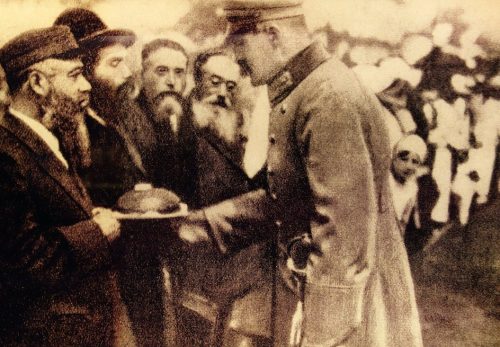
Jozef Pilsudski: Founding Father of Modern Poland by Professor Joshua D. Zimmerman
Response by Professor Jolanta Żyndul
Part II
Focusing on Chapter 14 State Builder:
Surrounded by challenges of war, pogroms, the Treaty of Versailles, the Polish-Bolshevik conflict intensifies,
“Miracle on the Vistula” and the Internment of Jewish Soldiers in Jablonna
February 15, 2026
10AM Los Angeles / 12N Chicago / 1PM New York / 6PM London / 7PM Warsaw / 8PM Jerusalem
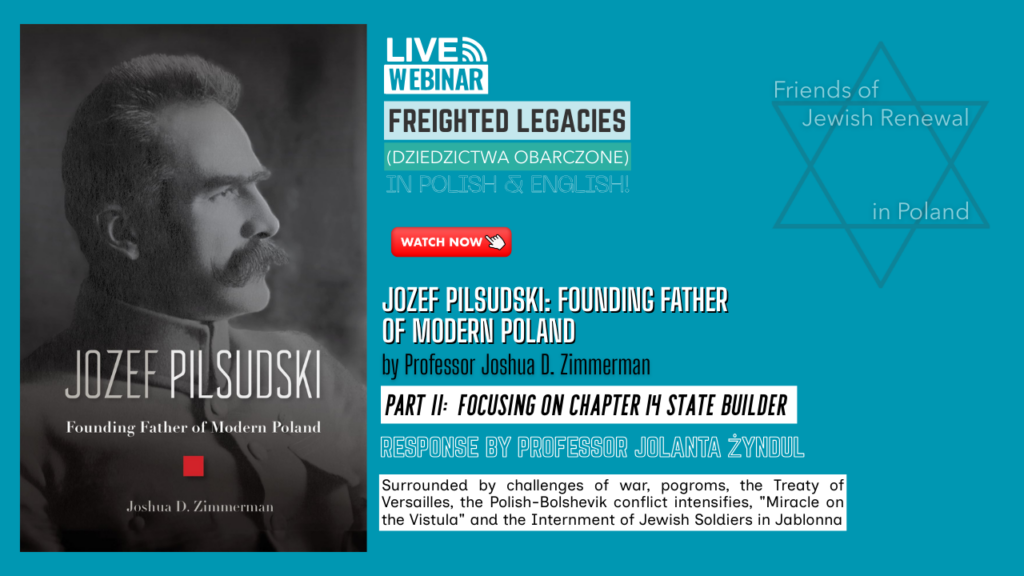
The story of the enigmatic Jozef Pilsudski, the founding father of modern Poland: a brilliant military leader and high-minded statesman who betrayed his own democratic vision by seizing power in a military coup.
In the story of modern Poland, no one stands taller than Jozef Pilsudski. From the age of sixteen he devoted his life to reestablishing the Polish state that had ceased to exist in 1795. Ahead of World War I, he created a clandestine military corps to fight Russia, which held most Polish territory. After the war, his dream of an independent Poland realized, he took the helm of its newly democratic political order. When he died in 1935, he was buried alongside Polish kings.
Yet Pilsudski was a complicated figure. Passionately devoted to the idea of democracy, he ceded power on constitutional terms, only to retake it a few years later in a coup when he believed his opponents aimed to dismantle the democratic system. Joshua Zimmerman’s authoritative biography examines a national hero in the thick of a changing Europe, and the legacy that still divides supporters and detractors. The Poland that Pilsudski envisioned was modern, democratic, and pluralistic. Domestically, he championed equality for Jews. Internationally, he positioned Poland as a bulwark against Bolshevism. But in 1926 he seized power violently, then ruled as a strongman for nearly a decade, imprisoning opponents and eroding legislative power.
In Zimmerman’s telling, Pilsudski’s faith in the young democracy was shattered after its first elected president was assassinated. Unnerved by Poles brutally turning on one another, the father of the nation came to doubt his fellow citizens’ democratic commitments and thereby betrayed his own. It is a legacy that dogs today’s Poland, caught on the tortured edge between self-government and authoritarianism.
BUY THE BOOK HERE
20% DISCOUNT CODE: ZIM20
(USD/GBP/EURO)
Valid 2/1/26 thru 2/28/26
READ CHAPTER 14 FROM THE BOOK (IN POLISH) HERE
BACKGROUND READING
PART I FROM AUGUST 2025 WEBINAR HERE
Article by Andrzej Brzeziecki – historian, journalist, and publicist.
A graduate of the Faculty of History at the Jagiellonian University.
READ HERE: Piłsudski Was a Democrat:
An Exchange between Joshua Zimmerman and Andrzej Brzeziecki
Joshua D. Zimmerman
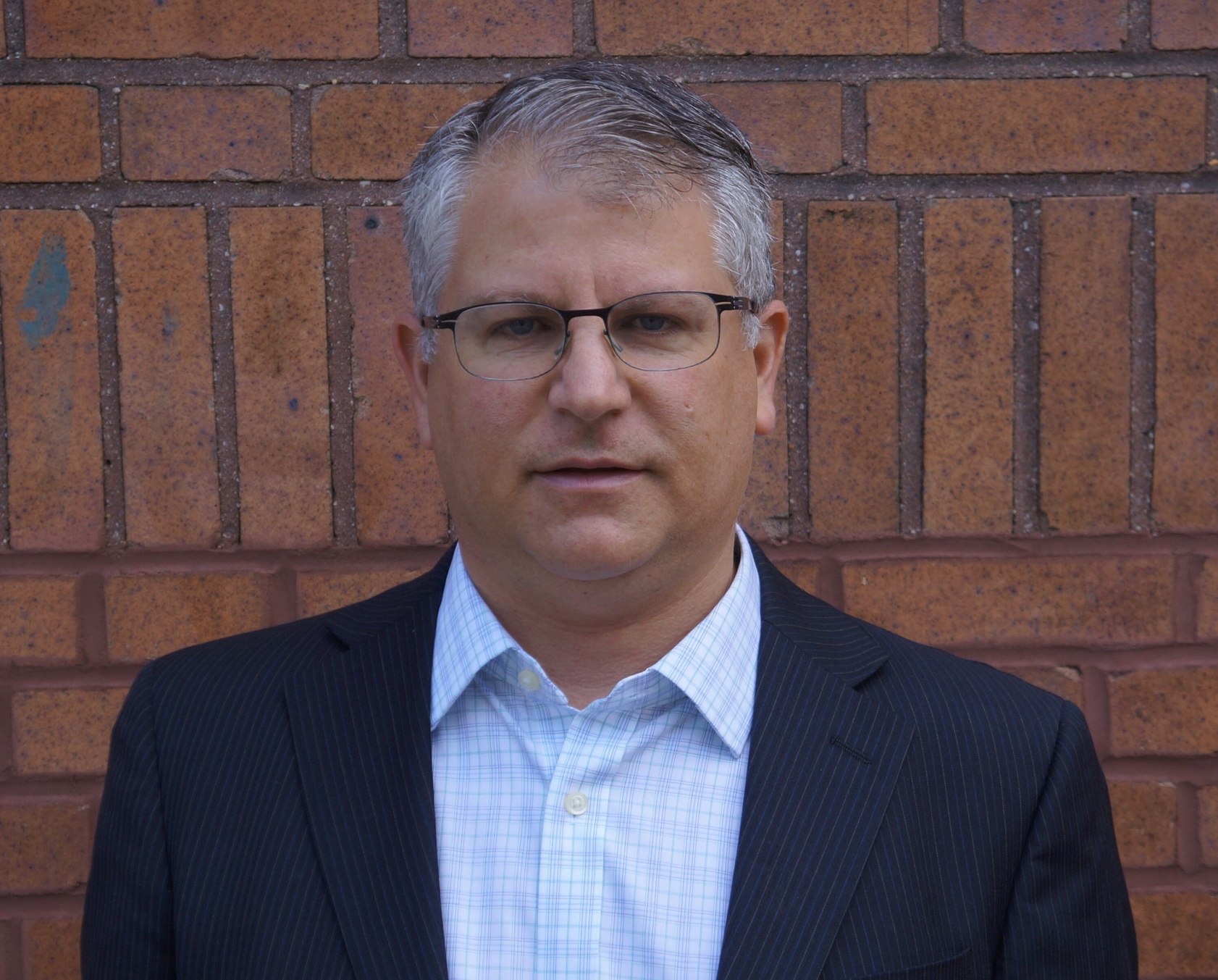
Joshua D. Zimmerman (born 1966) holds the Eli and Diana Zborowski Professorial Chair in Holocaust Studies and East European Jewish History at Yeshiva University.[1][2] He is the author or editor of several works about the Holocaust, including Contested Memories. Poles and Jews during the Holocaust and Its Aftermath (2003) and The Polish Underground and the Jews, 1939–1945 (2015).[3]
Zimmerman graduated from the University of California, Santa Cruz, in 1989 with a BA in history. He was awarded an MA in history from the University of California, Los Angeles, in 1993 and a PhD in comparative history from Brandeis University in February 1998. He is proficient in Yiddish, Polish, Hebrew, Russian, and French. In 2004 he was appointed an associate professor of history at Yeshiva University in New York City.[4]
Contested Memories (2003), a volume Zimmerman edited, was described by the publisher as “the first attempt since the fall of Communism to reassess the existing historiography of Polish-Jewish relations just before, during, and after the Second World War“.
His 2015 book, The Polish Underground and the Jews, 1939–1945, received a number of overall positive reviews. In Yad Vashem Studies, Antony Polonsky praised the book as a “fair and dispassionate study” which seeks to “reach a conclusion on the actual behavior of the AK [Poland’s Home Army]”.[6] Theodore R. Weeks, of Southern Illinois University, Carbondale, writes in The Polish Review: “The real achievement of Zimmerman’s book is to present the light and shadow in the perspective of these difficult years, to note specific facts and trends, and to avoid overly broad generalizations.”[7]
- (2003), ed. Contested Memories: Poles and Jews during the Holocaust and its Aftermath. New Brunswick and London: Rutgers University Press. ISBN 978-0-8135-3158-8.
- (2004). Poles, Jews and the Politics of Nationality: the Bund and the Polish Socialist Party in Late Tsarist Russia, 1892–1914. Madison: The University of Wisconsin Press.
- (2005), ed. The Jews of Italy under Fascist and Nazi Rule, 1922–1945. Cambridge: Cambridge University Press.
- (2015). The Polish Underground and the Jews, 1939–1945. Cambridge and New York: Cambridge University Press. ISBN 9781107014268.
- (2022). Jozef Pilsudski: Founding Father of Modern Poland. Harvard University Press. (purchase here, 20% DISCOUNT CODE: ZIM20 (USD/GBP/EURO),Valid 2/1/26 thru 2/28/26)
(Source: Wikipedia)
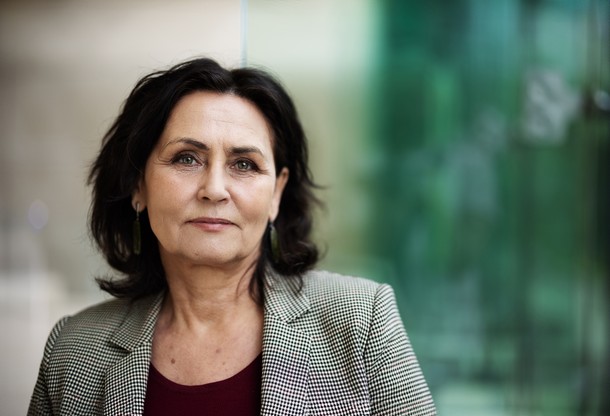
Response by Professor Jolanta Żyndul
Jolanta Maria Żyndul (born 1964) is a Polish historian, a specialist on modern Jewish history and Polish-Jewish relations in the 19th and 20th centuries.
(Source: Wikipedia)
She joined the historical faculty of the John Paul II University of Lublin, but later moved to Warsaw, where she graduated in 1990 from the Faculty of History of University of Warsaw. Since 1991 she works for the university’s Mordechaj Anielewicz Centre for the Study and Teaching of the History and Culture of Jews in Poland, initially as a technical assistant, then assistant professor (1992–1999) and since 1999 as an adjunkt. When Jerzy Tomaszewski retired in 2001, she replaced him as director of that institution.[1]
In 1999 she received a doctoral degree (under tutelage of prof. Marcin Kula),[1] and in January 2013 she received habilitation.[2]
She also works as a chief specialist at the POLIN Museum of the History of Polish Jews[2] and teaches as a visiting scholar at the Jagiellonian University.[3]
Her 2011 book Kłamstwo krwi (The Blood Libel) is a monograph on the perseverance of the belief that Jews sacrifice humans as part of their religion. It received favourable reviews.[4][5]
In 2000 she received the KLIO award for her monograph Państwo w państwie? on the national and cultural autonomy in Central-Eastern Europe in the 20th century. In 2007 she was awarded with the Warsaw Ghetto Uprising commemorative medal.
BACKGROUND READING
PART I FROM AUGUST 2025 WEBINAR HERE
Article by Andrzej Brzeziecki – historian, journalist, and publicist.
A graduate of the Faculty of History at the Jagiellonian University.
READ HERE: Piłsudski Was a Democrat:
An Exchange between Joshua Zimmerman and Andrzej Brzeziecki
RELATED CONTENT
August 24, 2025 Freighted Legacies Webinar
A FULL LIST OF FREIGHTED LEGACIES EVENTS ARE HERE.
DONATE TO SUSTAIN THE FREIGHTED LEGACIES SERIES HERE.
ALL FREIGHTED LEGACIES BLOG POSTS ARE HERE.
SUBSCRIBE TO OUR YOUTUBE CHANNEL!
Click “subscribe”, it’s free!
1,000 subscribers needed to monetize our channel!