In 2009, Laurel was living in Prague, aimless and bartending when a “nice Moravian guy” took her to buy pickles in Poland. “I wound up on a second date, skidding around snow drifts to cross the border into Poland, the first time anyone in my family had been back in about a hundred years.” Carrying an enormous plastic pickle bucket between them, the couple eventually stumbled into a local bakery, where Laurel found herself ogling an “almost impossible variety” of beautiful baked goods. The experience launched her love affair with Polish baking, and pushed her further toward her culinary career. She’s now a French-trained baker and the owner of Berlin’s acclaimed Fine Bagels. And she married that nice Moravian guy. […]
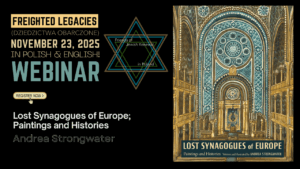
Andrea Strongwater’s Lost Synagogues of Europe
Paintings and Histories
Lost Synagogues of Europe recreates in vivid color paintings and chronicles the life stories of nearly eighty majestic— and destroyed— European synagogues, each one a testament to the approximately 17,000 synagogues decimated during the Third Reich and early takeover of the Communist regimes. After WWII only about 3,300 buildings remained standing, and just 700+ are still in use as synagogues. This exquisite and significant work of historical preservation collects, organizes, and documents their stories.
Freighted Legacies has invited Andrea Strongwater to focus on the synagogues in the Polish Lands which include close to 20 locations. The imagination is drawn into a reflection of the missing material culture of Jewish life.[…]
The Holocaust in Eastern European Memory and Politics after the Cold War
In this talk, Dr. Michlic discusses a crucial shift in the process of memorialization of the Holocaust in post-communist Eastern Europe that has occurred around the year of 2010. Despite its limitations, the 1989 – early 2000s liberal phase of memorialization of the Holocaust in postcommunist Europe was conducive to the emergence for the first time of critical history writing about the Holocaust, driven by local Jewish and non-Jewish senior and junior scholars living in their respective homelands or abroad. It also resulted in highly emotionally charged public and historical debates, such as the well-known international Polish debate of 2000 – 2002, about the Jedwabne massacre of 10 July 1941, which aimed at coming to terms with the difficult history of the treatment of the Jewish minority during the Holocaust. However, by the beginning of the second decade of the twenty-first century, troubling undercurrents of the memorialization of the Holocaust, with continuing antisemitic-based prejudices towards Jewish victims and Jewish survivors, have exploded and ascended forcefully. As a result, the memorialization of the Holocaust has been subjected to instrumentalization, abuses, and attacks from a wide range of social, cultural, and political actors as never before. This talk explores the post-2010 shifts in approaches and their cultural significance.
Sons of Survivors
The authors of this dual memoir did not live through the trauma of the Holocaust; they inherited it. Whether their survivor parents revealed what they endured or erected barriers of silence, the horrors they experienced permeated the lives of their children. The arrival of their book opens a door not only to their friendship and their pasts but it also invites other “sons and daughters of survivors.”
- « Previous Page
- 1
- 2
- 3
- 4
- …
- 12
- Next Page »