Friends of Jewish Renewal in Poland
PAST WEBINARS
JUNE 14, 2026
The “Barefoot Rabbi” and the Evolution of an Iconic Holocaust Photograph
WATCH THIS WEBINAR (ENGLISH)
WATCH THIS WEBINAR (POLISH)
READ THIS BLOG POST HERE
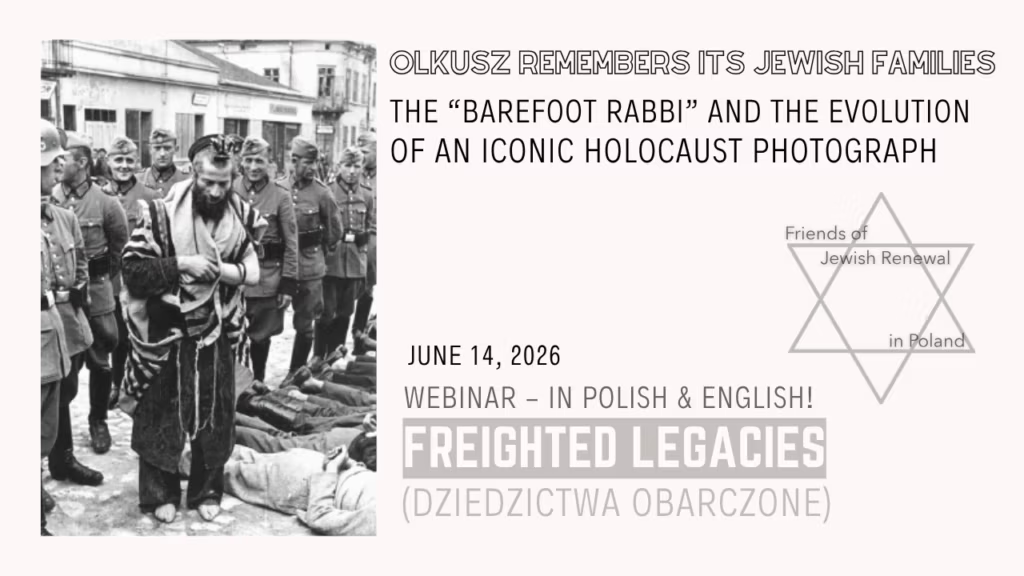
Please join us for a webinar in Polish, English, and perhaps Hebrew, on June 14, 2026, for a gathering of descendants of Olkusz and the Zagłębie region, including Sosnowiec, Będzin, and Dąbrowa Górnicza, a distinct historical region adjacent to Upper Silesia and historically connected with Lesser Poland. This webinar arose from our talks related to a translation to English of the Krzysztof Kocjan book “Jewish Olkusz.” We realized Olkusz descendants are dispersed over the world but possess elements of a common heritage. Our purpose for June 14, 2026 is to create a friendly platform for keeping the memory alive.
KEEP READING
MAY 10, 2026
Introduction to the Exilic Worlds of Zygmunt Bauman: Sociologist, Philosopher, and Skeptic
The Fate of “Zionists” Expelled from Poland in 1968

READ THIS BLOG POST HERE
WATCH THIS WEBINAR (ENGLISH)
WATCH THIS WEBINAR (POLISH)
Zygmunt Bauman was one of the great social thinkers of our time: the inventor of the idea of “liquid modernity.” Bauman transformed our thinking about the social conditions shaping our lives today. His own life was shaped by the great social forces that scarred the second half of the twentieth century – war, communism, antisemitism, and forced migration (exile from Poland). His work bears the traces of an outsider (Jew?) who knew all too well the enormous impact that social and political forces can have on individuals and whole societies.
KEEP READING
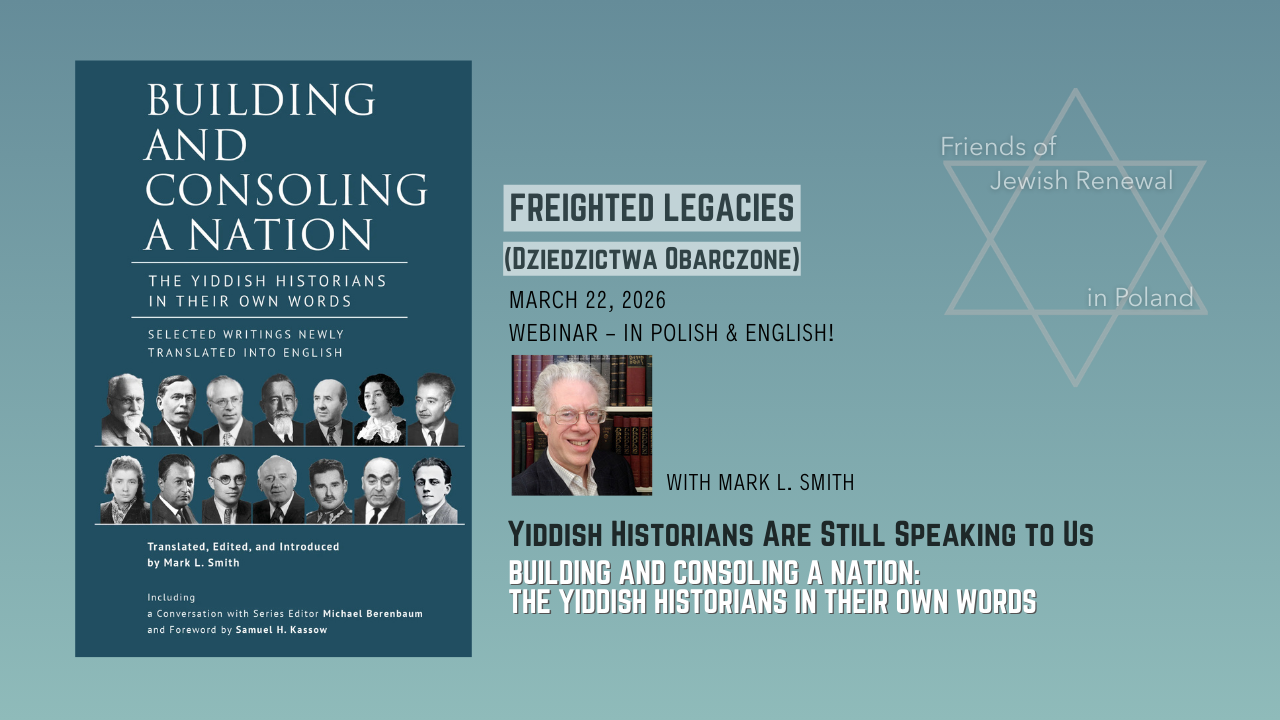
March 22, 2026
Yiddish Historians Are Still Speaking to Us
Building and Consoling a Nation:
The Yiddish Historians in Their Own Words
READ THIS BLOG POST HERE
WATCH THIS WEBINAR (ENGLISH)
WATCH THIS WEBINAR (POLISH)
In the early twentieth century, when the dream of Jewish cultural nationalism in the Diaspora was growing among champions for Yiddish, its leading intellectuals included the “Yiddish historians” who helped to uncover the history of East-European Jews. Before the Holocaust, their mission was to discover and present the formative history of a living people to an audience of educated lay leaders, drawing, where possible, on Jewish sources, in order to help build and fortify a Yiddish-speaking nation. After the Holocaust, their mission became to console its surviving remnant with information about the struggle to survive under German occupation. This book makes Yiddish writings by these historians available in English for the first time, with translations by historian Mark L. Smith.
>>>KEEP READING
DONATE TO SUSTAIN OUR WORK
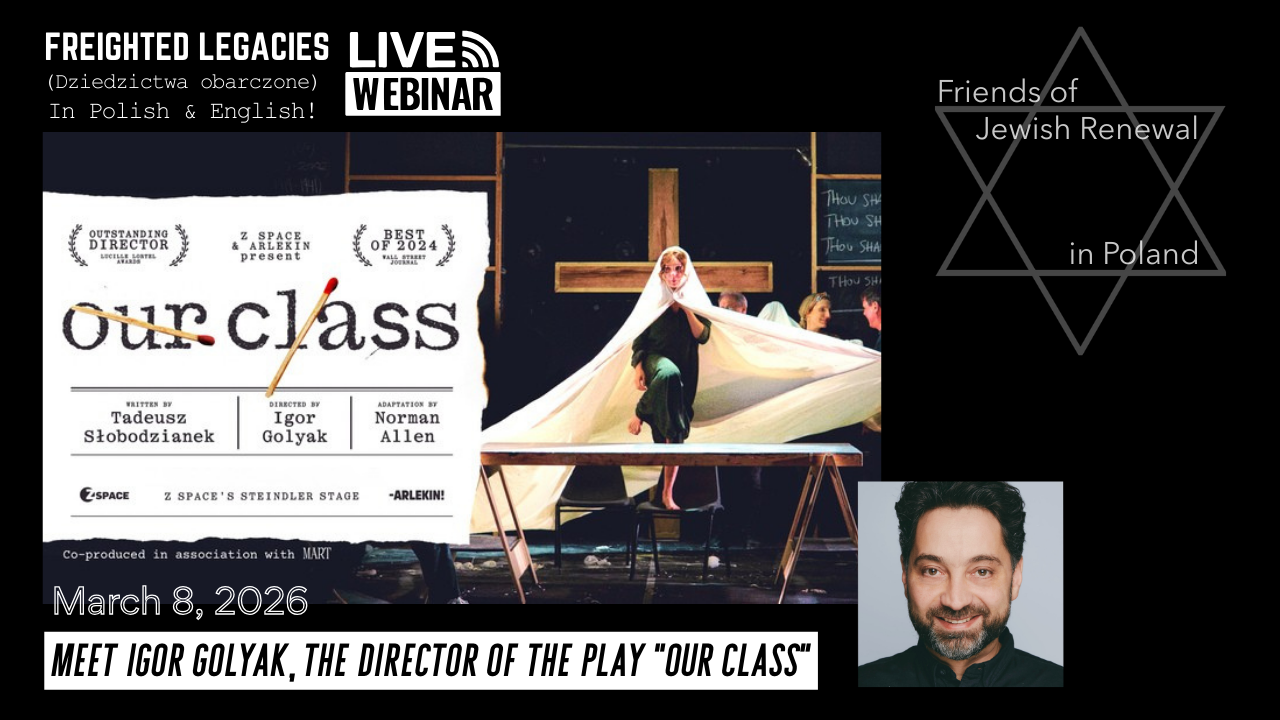
March 8, 2026
Meet Igor Golyak, the Director of the Play “Our Class”
READ THIS BLOG POST HERE
WATCH THIS WEBINAR (ENGLISH)
WATCH THIS WEBINAR (POLISH)
March 8 at 10 am, Jewish Renewal in Poland’s webinar Freighted Legacies will interview Igor Golyak, the director of the enormously successful play “Our Class.” Igor Golyak is the founder and muse of Arlekin productions. Our webinar will focus on the genesis of this play in its American version.
“Our Class” follows ten classmates—five Jewish and five Catholic—who grow up as friends in a small Polish village. Inspired by the real-life events of the 1941 Jedwabne massacre—where Polish neighbors murdered hundreds of their Jewish classmates and friends—this story traces their lives over eight decades as they turn against one another, driven by entrenched antisemitism and external forces. It is a shocking, timely, and deeply human journey.
>>>KEEP READING HERE
FEBRUARY 15, 2026
Jozef Pilsudski: Founding Father of Modern Poland by Professor Joshua D. Zimmerman
Response by Professor Jolanta Żyndul
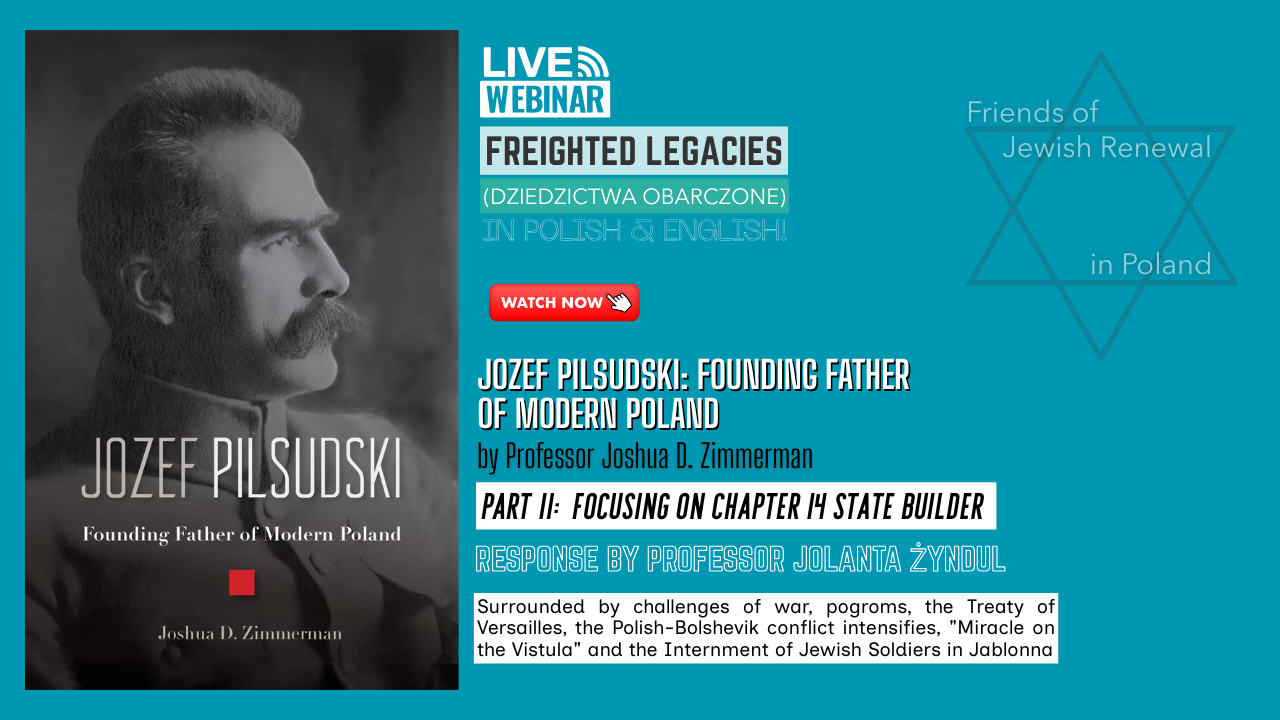
Part II: Focusing on Chapter 14 State Builder: Surrounded by challenges of war, pogroms, the Treaty of Versailles, the Polish-Bolshevik conflict intensifies, "Miracle on the Vistula" and the Internment of Jewish Soldiers in Jablonna
READ THIS BLOG POST HERE
WATCH THIS WEBINAR (ENGLISH) HERE
WATCH THIS VIDEO (POLISH) HERE
The story of the enigmatic Jozef Pilsudski, the founding father of modern Poland: a brilliant military leader and high-minded statesman who betrayed his own democratic vision by seizing power in a military coup.
In the story of modern Poland, no one stands taller than Jozef Pilsudski. From the age of sixteen he devoted his life to reestablishing the Polish state that had ceased to exist in 1795. Ahead of World War I, he created a clandestine military corps to fight Russia, which held most Polish territory. After the war, his dream of an independent Poland realized, he took the helm of its newly democratic political order. When he died in 1935, he was buried alongside Polish kings. >>>KEEP READING HERE
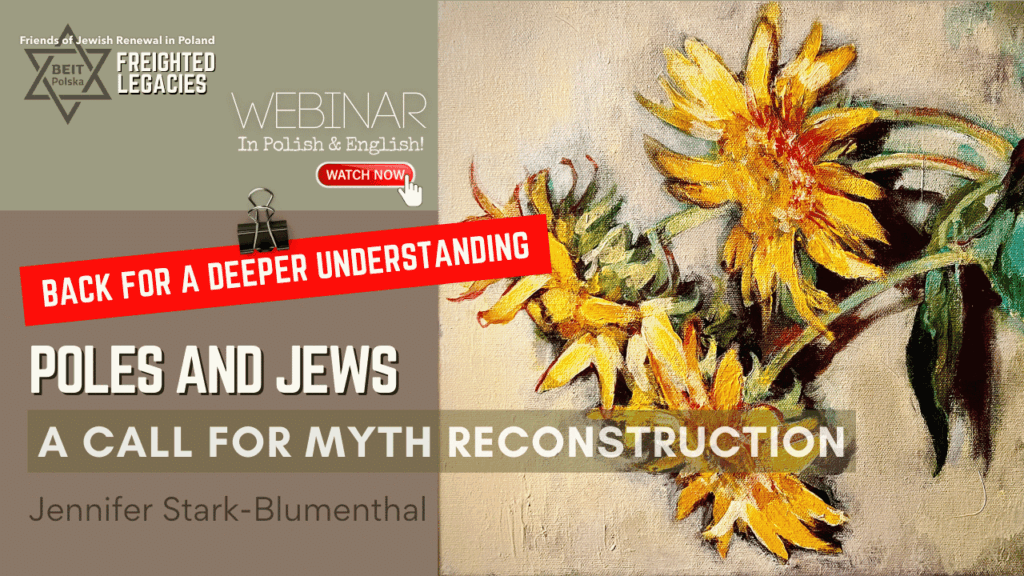
POLES and JEWS: A Call for Myth Reconstruction
Back for a Deeper Understanding
WATCH THIS WEBINAR (ENGLISH) HERE
WATCH THIS VIDEO (POLISH) HERE
READ THIS BLOG POST HERE
JANUARY 11, 2026
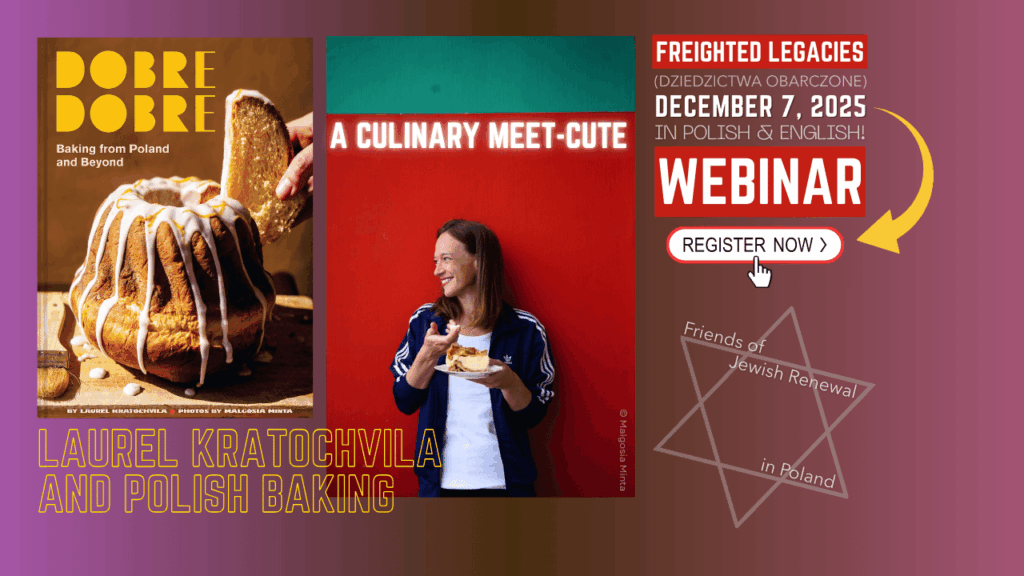
Laurel Kratochvila and Polish Baking
A Culinary Meet-Cute
VIDEO COMING SOON!
READ THIS BLOG POST HERE
DECEMBER 7, 2025
In 2009, Laurel was living in Prague, aimless and bartending when a “nice Moravian guy” took her to buy pickles in Poland. “I wound up on a second date, skidding around snow drifts to cross the border into Poland, the first time anyone in my family had been back in about a hundred years.” Carrying an enormous plastic pickle bucket between them, the couple eventually stumbled into a local bakery, where Laurel found herself ogling an “almost impossible variety” of beautiful baked goods. The experience launched her love affair with Polish baking, and pushed her further toward her culinary career. She’s now a French-trained baker and the owner of Berlin’s acclaimed Fine Bagels. And she married that nice Moravian guy.
The inextricable overlap of Jewish and Polish baking: Kratochvila’s own bakery, Fine Bagels, specializes in Jewish-American baked goods. She’s also of Polish-Jewish descent herself. The more she learned about Polish baking the more connected she felt with her own roots—and the more she recognized the overlap between Jewish and Polish baking. Dobre Dobre emphasizes the essential contributions of Jewish bakers and their indelible influence on Poland’s bakery canon. The book not only traces their journeys beyond Poland, but their place in—and sometimes return to—Poland’s contemporary baking scene.
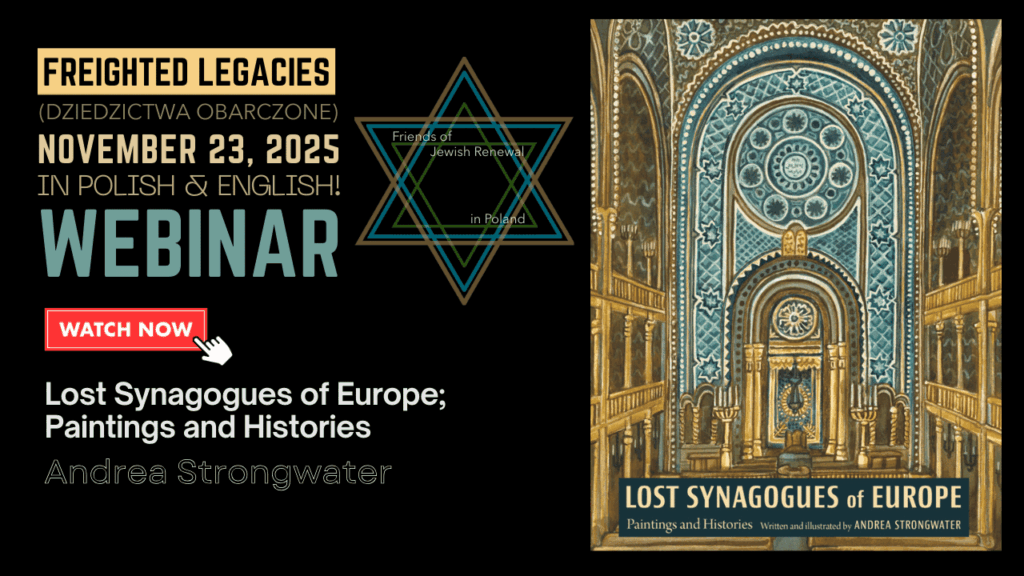
Andrea Strongwater’s Lost Synagogues of Europe
Paintings and Histories
READ THIS BLOG POST HERE
WATCH THIS WEBINAR (ENGLISH) HERE
WATCH THIS VIDEO (POLISH) HERE
NOVEMBER 23, 2025
Lost Synagogues of Europe recreates in vivid color paintings and chronicles the life stories of nearly eighty majestic— and destroyed— European synagogues, each one a testament to the approximately 17,000 synagogues decimated during the Third Reich and early takeover of the Communist regimes. After WWII only about 3,300 buildings remained standing, and just 700+ are still in use as synagogues. This exquisite and significant work of historical preservation collects, organizes, and documents their stories.
Freighted Legacies has invited Andrea Strongwater to focus on the synagogues in the Polish Lands which include close to 20 locations. The imagination is drawn into a reflection of the missing material culture of Jewish life.
In four chapters organized by inauguration dates (1600s, 1700s, 1800s, and 1900s), author and artist Andrea Strongwater shines light on seventy-seven synagogues built from the early 1600s to 1930 and spanning sixteen European countries where destruction was rampant: Austria (6 synagogues), Belarus (3), Croatia (2), the Czech Republic (5), Estonia (1), France (2), Germany (26), Italy (1), Latvia (2), Lithuania (5), Luxembourg State (1), The Netherlands (1), Poland (15), Russia (1), Slovakia (2), and Ukraine (4). She lovingly illustrates their exteriors and/or interiors and tells stories of their history, Jewish community, and architectural significance. > > KEEP READING HERE
The Holocaust in Eastern European Memory and Politics after the Cold War:
The Case of Poland, 1989 -2025
READ THIS BLOG POST HERE
WATCH THIS WEBINAR (ENGLISH) HERE
WATCH THE VIDEO (POLISH) HERE
NOVEMBER 9, 2025
In this talk, Dr. Michlic discusses a crucial shift in the process of memorialization of the Holocaust in post-communist Eastern Europe that has occurred around the year of 2010. Despite its limitations, the 1989 – early 2000s liberal phase of memorialization of the Holocaust in postcommunist Europe was conducive to the emergence for the first time of critical history writing about the Holocaust, driven by local Jewish and non-Jewish senior and junior scholars living in their respective homelands or abroad. It also resulted in highly emotionally charged public and historical debates, such as the well-known international Polish debate of 2000 – 2002, about the Jedwabne massacre of 10 July 1941, which aimed at coming to terms with the difficult history of the treatment of the Jewish minority during the Holocaust. However, by the beginning of the second decade of the twenty-first century, troubling undercurrents of the memorialization of the Holocaust, with continuing antisemitic-based prejudices towards Jewish victims and Jewish survivors, have exploded and ascended forcefully. As a result, the memorialization of the Holocaust has been subjected to instrumentalization, abuses, and attacks from a wide range of social, cultural, and political actors as never before. This talk explores the post-2010 shifts in approaches and their cultural significance.
Sons of Survivors; Making Peace with Inherited Trauma
A Joint Memoir by Aron Hirt-Manheimer and Marty Yura
READ THIS BLOG POST HERE
WATCH THIS WEBINAR (ENGLISH) HERE
WATCH THE VIDEO (POLISH) HERE
October 5, 2025 – Two lifelong friends uncover their families’ long-hidden Holocaust history, confronting silence, reclaiming memory, transforming inherited trauma into a powerful legacy of love.
The authors of this dual memoir did not live through the trauma of the Holocaust; they inherited it. Whether their survivor parents revealed what they endured or erected barriers of silence, the horrors they experienced permeated the lives of their children.
Aron Hirt-Manheimer and Marty Yura grew up in the close-knit community of Yiddish-speaking refugees in America. After meeting in Los Angeles as high school students, the two became fast friends with much in common, including the fact that they were both conceived in the same displaced persons camp in US-occupied Germany.
This book traces their colorful growing-up adventures through fast-paced alternating passages. Though the Holocaust formed the backdrop of their lives, they didn’t talk much about it—until, as older adults, they embraced the imperative to bear witness. They set out to discover everything they could about what happened to their parents and other relatives in German Nazi-occupied Poland during World War II, where the German Nazi concentration camps were built.
This joint memoir attests to a legacy of love against hate.
Being A Polish Rabbi in the 21st Century:
A Life of Service and Challenge
READ THIS BLOG POST HERE
WATCH THIS WEBINAR HERE
WATCH THE VIDEO (POLISH) HERE
Once, the term Polish rabbi was a reference to a ubiquitous type. Today, Rabbi Mati Kirschenbaum is a part of a unique modern phenomenon of modern urbane learned Jewish leaders with a wide range of skills. From pastoral work to engagement with modern culture, Rabbi Kirschenbaum has inspired the families Kol Tikvah.
Where possible, Rabbi Mati has lent a hand to the revival of Progressive Polish Jewish life.
Rabbi Mati was born in Wroclaw, Poland, one of the birthplaces of the European Reform movement. His family, like many European Jews after the Shoah, kept their Jewish heritage a secret. As a result, Rabbi Mati got involved in Jewish life as a teenager. During his college years in Warsaw, where he read Economics and Management, Mati became passionate about Progressive Judaism. Following graduation from college, Rabbi Mati worked as a Jewish educator in Polish non-profits. Rabbi Mati’s love of teaching Judaism motivated him to apply to rabbinical school. Rabbi Mati studied for the rabbinate at Abraham Geiger Kolleg in Germany and at the Conservative Yeshiva in Jerusalem. He was ordained as a rabbi at the Leo Baeck College in London. After ordination, Mati worked as a community Rabbi in Reform synagogues in London.
Rabbi Mati unwinds on long walks and mountain hikes in his spare time. He also enjoys learning about local history, studying foreign languages (currently Spanish and French), and searching for the best coffee and Indian food in Orange County.
Józef Piłsudski (1867-1935) in Jewish Collective Memory
PART 1: The Bund and the Polish Socialist Party in Late Tsarist Russia, 1892–1914
READ THIS BLOG POST HERE
WATCH THIS WEBINAR HERE
WATCH THE VIDEO (POLISH) HERE
Poland’s modern-day emergence is connected to many storied names, but none exceeds Josef Pilsudski, the modern-day military hero, socialist activist, and head of state.
As leader of the Polish Socialist Party in Imperial Russia from the 1890s to 1914, Józef Piłsudski championed a free, democratic Poland in which all citizens, regardless of religion or nationality, would receive equality before the law. As party leader before 1914, Piłsudski organized a Jewish Section, sponsored a Yiddish party press to compete with the Jewish Labor Bund, and advocated for the separation of Poland from the three empires (Austro-Hungarian, German, and especially Imperial Russia). As commander of the Polish Legions in World War I, Piłsudski led a Polish armed force in which 10% of its fighters were Polish Jews. When Poland re-emerged on the map of Europe in November 1918, Piłsudski was named commander-in-chief and head of state. Interwar Poland’s Jewish community – the largest in Europe – regarded Piłsudski as their protector and feared for their future upon his death in May 1935. Their premonition came true all too soon. The consensus in Polish Jewish diaries, testimonies, and memoirs is that Pilsudski was a great and decent man. Why is he virtually unknown today?
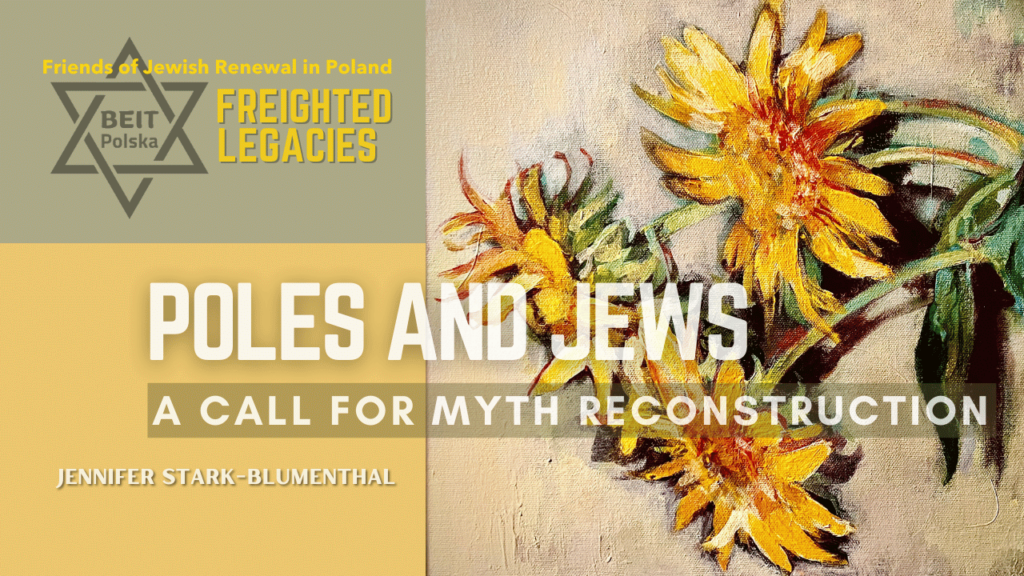
POLES and JEWS: A Call for Myth Reconstruction
Comprehensive Research
READ THIS BLOG POST HERE
WATCH THIS WEBINAR HERE
WATCH THE VIDEO (POLISH) HERE
June 8, 2025 – Independent researcher Jennifer Stark-Blumenthal will present Poles and Jews: A Call for Myth Reconstruction, an expansive and engaging investigation into centuries of changing Polish-Jewish relations. With forthright honesty the author calls on Poles and Jews to recognize and challenge the “myths” each tells about the other and themselves.
Through accessible language, Stark-Blumenthal brings the complexity of history to the reader while proposing an important moral reckoning for both Poles and Jews. Through a clear-eyed inspection of the past, this book invites a new moment to emerge in Polish-Jewish relations.
The dean of Polish/Jewish historians, Antony Polonsky, will join the conversation. This will be the second time that Professor Polonsky has joined us (see Barry Cohen’s Opening the Drawer: The Hidden Identities of Polish Jews). Polonsky is the senior editor of series of Jews of Poland.
READ THIS BLOG POST HERE
WATCH THIS WEBINAR HERE
WATCH THE VIDEO IN POLISH HERE
April 27, 2025 – Rokhl Auerbach’s many careers as a writer, philosopher, historian, Yiddish language advocate, and survivor are eclipsed by the outsized role she played in preserving the record of the Holocaust. In the Warsaw Ghetto, Emmanuel Ringelblum conceived and organized over sixty people for his Oneg Shabbat archive. Auerbach worked the Ghetto’s soup kitchen and chronicled the struggle to maintain life. Auerbach was one of three people that knew of the buried archive, She remained in Poland to work on those materials when they were discovered and to collect other testimonies.
Dr. Samuel Kossow’s Who Will Write Our History is now augmented with the translation of Auerbach’s Warsaw Testament including Kassow’s annotations. Auerbach devoted her life to documenting the Warsaw Ghetto struggle through her work at Yad VaShem, initially in Yiddish and eventually in Hebrew. Roberta Grossman’s documentary, Who Will Write Our History featured the character of Auerbach.
Dr. James Diamond's forthcoming book "Raging Hassidic Sermons of R. Kalonymous Kalman Shapira”
READ THIS BLOG POST HERE
WATCH THIS WEBINAR HERE
WATCH THE VIDEO IN POLISH HERE
March 23, 2025 – Dr. James Diamond’s book on “Raging Hassidic Sermons of R. Kalonymous Kalman Shapira” will soon be published. We are fortunate to hear of the unique teachings of a Hassidic master known as the Piaseczner Rebbe. R. Kalonymous Kalman Shapira continued to deliver sermons from September 1939 until the summer of 1942. Sermons from the Years of Rage and his other writings were included in the buried archives of the Warsaw Ghetto known as Oneg Shabbat.
Dr. Diamond will apply his deep learning to introduce us to this Hassidic teacher’s profound thinking in the midst of the struggle to survive.
Dr. James A. Diamond holds the Joseph and Wolf Lebovic Chair of Jewish Studies at the University of Waterloo. His vast writings include Jewish Theology Unbound, and Maimonides and The Shaping of the Jewish Canon, as well as numerous articles.
READ THIS BLOG POST HERE
WATCH THIS WEBINAR HERE
WATCH THE VIDEO IN POLISH HERE
January 12, 2025 – When Jews visit Poland, the past can present itself as a complex matter. Historian Bernheim created a unique people-to-people experience that framed his visit to his great-grandfather’s village. Robert Bernheim’s third visit to his great grandfather’s Polish hometown, Kanczuga, Poland, and the place of the old bakery was an inspired attempt to connect to the town’s residents. He began making bagels. Over thirty years of visiting Poland, Professor Bernheim has formed important ideas about what we should seek in these visits. Join in an intimate journey told by an unusual “bagel” emissary.
CONTINUE READING
READ THIS BLOG POST HERE
WATCH THIS WEBINAR HERE
WATCH THE VIDEO IN POLISH HERE
December 15, 2024 – Poland, the epicentre of the Holocaust, began denying responsibility as soon as the Nazi atrocities ended. The nation’s distortion of history continues today – with disturbing consequences. World-renowned Holocaust historian Jan Grabowski examines how the government, museums, schools and state never came to grips with the dark past. This tour de force reminds one of the power of historical research based on documents and historical reasoning.
Professor Grabowski’s research includes the issues surrounding the extermination of the Polish Jews as well as the history of the Jewish-Polish relations during the 1939-1945 period. He is the author of several monographs, including Hunt for the Jews and On Duty. Professor Grabowski has recently completed a project dealing with the involvement of the Polish “Blue” and criminal police in the Holocaust. His forthcoming research focuses on the open ghettos in the Generalgouvernement. A recipient of the 2014 Faculty of Arts Professor of the Year Award.
READ THIS BLOG POST HERE
WATCH THIS WEBINAR HERE
WATCH THE VIDEO IN POLISH HERE
April 7, 2024 – The Light of Learning tells the story of an unexpected Hasidic revival in Poland on the eve of the Holocaust. In the aftermath of World War I, the Jewish mystical movement appeared to be in shambles. Hasidic leaders had dispersed, Hasidic courts lay in ruins, and the youth seemed swept up in secularist trends as a result of mandatory public schooling and new Jewish movements like Zionism and Socialism. Author Glenn Dynner shows that in response to this, Hasidic leaders reinvented themselves as educators devoted to rescuing the youth by means of thriving networks of heders (primary schools), Bais Yaakov schools for girls and women, and world-renowned yeshivas.
During the ensuing pedagogical revolution, Hasidic yeshivas soon overshadowed courts, and Hasidic leaders became known more for scholarship than miracle-working. By mobilizing Torah study, Hasidic leaders were able to subvert the “civilizing” projects of the Polish state, successfully rival Zionists and Socialists, and create clandestine yeshiva bunkers in ghettos during the Holocaust. Torah study was thus not only a spiritual-intellectual endeavor but a political practice that fueled a formidable culture of resistance. The Light of Learning belies notions of late Hasidic decadence and decline and transforms our understanding of Polish Jewry during its final hour.
Turning Points in Jewish History: A Polish Translation
A Roundtable Discussion with Rabbis Marc Rosenstein, Barry Schwartz, Menachem Mirski, Mati Kirschenbaum, Drs. Miroslaw Patalon, and Dominika Zakrzewska
READ THIS BLOG POST HERE
WATCH THIS WEBINAR HERE
WATCH THE VIDEO IN POLISH HERE
March 17, 2024 – The Polish translation of Rabbi Marc Rosenstein’s Turning Points in Jewish History will give the Polish reading public a greater understanding of Jewish history. The historical volume makes accessible over thirty pivotal moments from biblical times to the near present to provide the reader with “the big picture.” Its teachers will augment and embellish the Polish version using text and online sources as a core. This is similar to the process developed by the Jewish Publication Society, which has licensed this effort.
The presentations focus on “turning points” from Hellenistic-Roman times, five in the Middle Ages and thirteen in modernity. A group of Polish-speaking Professors and educators will work to adapt the lesson plans to Polish realities alongside adult education leaders such as Rabbi Barry Schwartz and other congregational leaders. We are pleased that noted translator Dorota Golebiewska has agreed to work on the central text. The committee of Polish and International scholars will develop accompanying materials.
READ THIS BLOG POST HERE
WATCH THIS WEBINAR HERE
WATCH THE VIDEO IN POLISH HERE
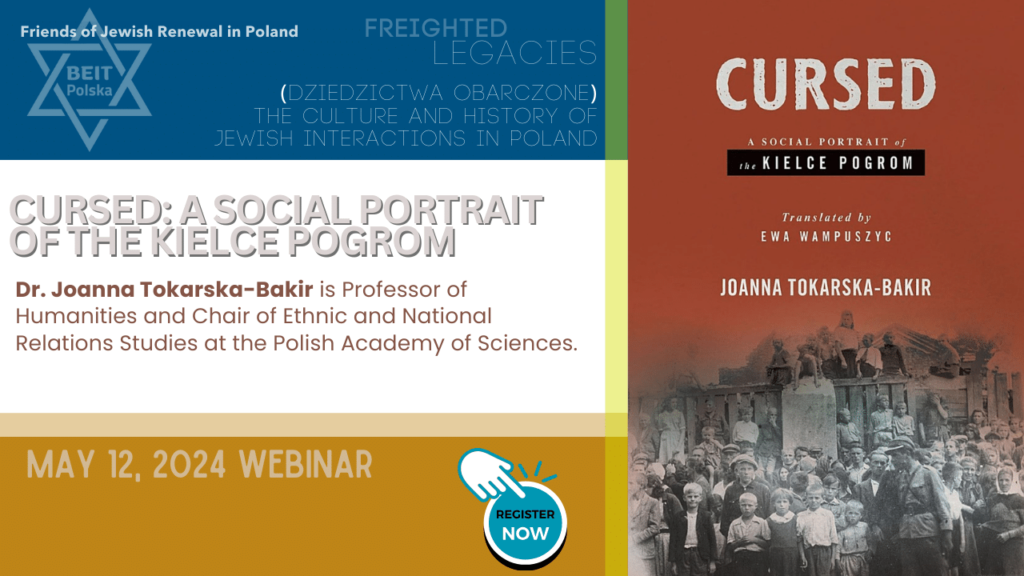
May 12, 2024 – In Cursed: A Social Portrait of the Kielce Pogrom, Joanna Tokarska-Bakir investigates the July 4, 1946, Kielce pogrom, a milestone in the immediate post-Holocaust events impacting Jewish life in Poland and the Jewish diaspora. This massacre compelled thousands of Polish Jews who survived the Holocaust to flee postwar Poland. It remains a negative reference point in the Polish historical narrative and represents a lack of reckoning with the role of antisemitism in postwar Polish society and identity politics.
Cursed is a microhistory that recreates the events of the Kielce pogrom step by step and examines the dominant hypotheses about the pogrom through the prism of previously classified archival evidence.
A Suddenly Familiar Voice
READ THIS BLOG POST HERE
WATCH THIS WEBINAR HERE
WATCH THE VIDEO IN POLISH HERE
January 21, 2024 – Professor Shoshana Ronen’s presentation based on her book, A Prophet of Consolation on the Threshold of Destruction will introduce us to the remarkable Polish Progressive Rabbi Ozjasz (Joshua) Thon. Until recently the legacy of Rabbi Thon’s intellectual and lived experience was shrouded by the Holocaust and subsequent events, most importantly the establishment of the state of Israel. Now, Rabbi Thon’s significance emerges for Diaspora communities committed to their national identity and to Jewish cultural and political Zionism. Today’s Jewish world may be astounded to learn that the largest number of Progressive Jews in the world once lived in pre-World War II Poland. Polish Jewry’s dilemmas and lessons are relevant to our moment. In Thon’s thinking Poland’s Progressive Jews would aspire ideologically/religiously to situate between the classical German Jewish reform and the Russian Jewish Haskalah. By following the long and complex career of this pre-Holocaust leader we will learn much about Progressive Polish Jewry. Dr. Ronen will introduce us to the remarkable pulpit orator, parliamentarian, Hebraist, Zionist polemicist and rabbi of the Krakow Temple Synagogue from 1896 – 1935.
READ THIS BLOG POST HERE
WATCH THIS WEBINAR HERE
WATCH THE VIDEO IN POLISH HERE
December 17, 2023 – Recent writing of children and grandchildren of Holocaust survivors is creating a new literary community genre. Transcending national boundaries, Second and Third Generation children of survivors are encountering each other. Dr. David Kader will lead us in his own exploration that is both literary and personal. He has recently written of his parents’ lives and will share two short memoirs and invite conversation about the role of memory in the Second Generation.
David Kader was born in a displaced persons camp in the American zone of occupied Germany after World War II. His parents were Holocaust survivors. His mother – Lola was from Radom, Poland and his father – Israel Moshe was from Grojec Poland. The family migrated to the United states in 1949.
Webinar participants will be encouraged to briefly reflect on their own Second and Third Generation memories.
A Provocative Reflection on Aharon Appelfeld’s Novel
READ THIS BLOG POST HERE
WATCH THIS WEBINAR HERE
WATCH THE VIDEO IN POLISH HERE
November 19, 2023 – Posthumously, Israeli author Aharon Appelfeld (died 2018) released his final book in English translation this Spring 2023. The haunting, evocative writer of over forty books who acquired the Hebrew language late in life may have come full circle. This last book, Poland, A Green Land‘s continuity with Appelfeld’s past writing, points to the confrontation of a second generation of Israeli Jews that grew up in an “Israeli” ethos of forgetting and being alienated from their European Jewish survivor generation (VIEW PDF). Ya’akov Fine, the main character, travels to Poland to recover his parents’ world for it retains significant meaning.
Marking the Polish Translation of Transcending Darkness: A Girl’s Journey Out of the Holocaust
READ THIS BLOG POST HERE
WATCH THIS WEBINAR HERE
WATCH THE VIDEO IN POLISH HERE
Estelle Glaser Laughlin is a child Holocaust survivor who was born in Warsaw, Poland, in 1929. We are marking the Polish translation of her book Transcending Darkness: A Girl’s Journey Out of the Holocaust. This interview and other testimonies by Mrs. Laughlin will constitute a curriculum unit for Polish High school students.
In September 1939, Estelle’s family lived in Warsaw when Poland was attacked.. Along with her parents and sister, Freda, they were confined to the 1.3 square mile Ghetto area. The book recounts their struggle to survive in the Ghetto during the deportations from July to September 1942. In April of 1943, their bunker was discovered leading to their brutal transport to Majdanek concentration camp. Estelle survives with her mother and sister through other forced labor camps, Starzysko and Chestochowa.
READ THIS BLOG POST HERE
WATCH THIS WEBINAR HERE
WATCH THE VIDEO IN POLISH HERE
Two Lviv ensembles – “Sheyne Meydelekh” of the AUJCF Hesed – Arieh” and “Shtrudl-Band” of the community of progressive Judaism “Teyva” are again pleased to perform in online format with a 1-hour concert and to introduce a wide audience to their original interpretation of the traditional and modern Jewish songs in Hebrew and Yiddish. We promise you many bright impressions!
This is a benefit concert to support the basic needs of the community, featuring the Lviv, Ukrainian Community Musical Groups from the Progressive Jewish community, Teyva.
An Aid Worker in a Time of Pogrom, Chaos, and Anguish During the Russian Civil War
Michael Nutkiewicz
READ THIS BLOG POST HERE
WATCH THIS WEBINAR HERE
WATCH THE VIDEO IN POLISH HERE
July 16, 2023 – Michael Nutkiewicz translated and expanded Eli Gumener’s Yiddish memoir, originally published in Lithuania in 1921. Entitled A Ukrainian Chapter. A Jewish Aid Worker’s Memoir of Sorrow, the memoir depicts the fate of Jewish communities caught in the middle of the Russian Civil War and the challenges of providing relief to Jewish communities. Gumener (1886-1941) was Michael Nutkiewicz’s uncle and worked for major aid organizations between World War I and World War II. Michael was unaware of his story until he discovered the book in his parents’ vast Yiddish library after they passed away. Gumener’s memoir is a highly valuable and rare historical source that focuses on the two most devastating years of pogroms in Ukraine, 1918-1920. Eli Gumener lived a courageous and vulnerable life during and after the Civil War, providing aid to victims but finally becoming a victim himself twenty years later in the Holocaust.
CONTINUE READING
With Igor Mikhaylov & Son, Ilan - A Father’s Day Reflection
READ THIS BLOG POST HERE
WATCH THIS WEBINAR HERE
WATCH THE VIDEO IN POLISH HERE
June 18, 2023 – A father, Igor Mikhaylov, took his Bar Mitzvah age son, Ilan on a trip to Poland in the Spring of 2023. They were spurred by Ilan’s Bar Mitzvah project at Temple Judea in Los Angeles, CA in November 2022. Ilan ambitiously raised funds for the Janusz Korczak Childcare Fund of Friends of Jewish Renewal in Poland for Progressive Judaism supporting Spynka. The support for the network of 90 Day Care Centers called “Spynka” was one of many encounters with the Poland of today, which is offering refuge to Ukraine’s women and children. Father and son visited remnants of Warsaw’s Jewish past in the former area of the Warsaw Ghetto. They celebrated a Progressive Jewish Passover Seder with Rabbi Matti Kirschenbaum and Hania Gawronska-Spiewak, and 80 other Jews. Yes, they went to a soccer game!
CONTINUE READING
The Rewriting of Holocaust History on the World’s 7th Most Popular Website
Featuring Dr. Shira Klein
 June 27, 2023 – For the past few years, a group of Wikipedia editors has been spreading disinformation on the history of the Holocaust. With no obvious ties to any government, they slowly but relentlessly hack away at reason and accuracy to promote ideological zeal, prejudice, and bias. Due to this group’s handiwork, Wikipedia’s coverage of Holocaust history follows a narrative touted by right-wing Polish nationalists. Its articles whitewash the role of Polish society in the Holocaust and bolster stereotypes about Jews, spinning fantastical tales about Jews’ involvement in large-scale crimes against Poles, and wildly inflating the scope of Jewish collaboration with the Nazis. Many editors have tried in vain to change the narrative over the years. How do so few editors – half a dozen at most – get away with twisting the truth?
Dr. Shira Klein, Associate Professor at Chapman University, focuses on Italian Jewry, Jewish migration, and the Holocaust. Her book Italy’s Jews from Emancipation to Fascism (Cambridge University Press, 2018) was selected as a finalist for the 2018 National Jewish Book Award and is under contract to be published in Hebrew. Dr. Klein also works in the digital humanities, especially the study of Wikipedia. Her co-authored article “Wikipedia’s Intentional Distortion of the History of the Holocaust” in the Journal of Holocaust Research has surpassed 41,000 views and has attracted international media coverage. It is under contract to be translated into Polish and Hebrew.
READ THIS BLOG POST HERE
VIDEO AVAILABLE UPON REQUEST (English or Polish)
EMAIL: RabbiBeliak@JewishRenewalinPoland.org
Good Practices and Challenges in Building Polish-Israeli Dialogue Among Young Adults
READ THIS BLOG POST HERE
WATCH THIS WEBINAR HERE
WATCH THE VIDEO IN POLISH HERE
Jewish minority has been a part of Polish society for over 1000 years, during which the country has experienced alternating periods of development and destruction. Polish-Jewish relations were particularly affected by the tragic period of the Holocaust. After the 1948 establishment of the state of Israel and the tightening of Soviet-dominated Poland, the problematic knowledge of shared history with widely different interpretations translated into the complexity of Polish-Israeli relations. It contributed to a build-up of mutual distrust.
During the last decade, we observed several initiatives that aimed to overcome mutual stereotypes and prejudices and establish dialogue and cooperation between the citizens of both countries. How the meetings are prepared and conducted is particularly important for their success—the aim of the study conducted by Dr. Dominika Zakrzewska was to examine whether and under what conditions contact between young adults from Poland and Israel affects mutual prejudice and attitudes towards each other as well as selected national and ethnic groups. During the presentation, there will also be discussed the good practices in creating a curriculum for such meetings to ensure the implementation of their objectives and the emerging difficulties.
CONTINUE READING
READ THIS BLOG POST HERE
WATCH THIS WEBINAR HERE
WATCH THE VIDEO IN POLISH HERE
07-04-22 – Good evening. I bring you greetings from my home city Los Angeles, with one of the largest Jewish populations in the world, approx.. 600,000! And I feel honored to share this solemn remembrance of the 1946 Kielce Pogrom with you. Music has always had healing powers and I hope that our program of classical music for violin, cello and piano will have a transformative and comforting effect for us.
I invited three musicians to join me to perform today: Marek Jezowski, violinist, is the president of Beit Polska, the Polish organization which promotes and facilitates progressive Judaism throughout Poland. The cellist, Dominik Płociński, is a serious young professional musician and a prizewinner in the prestigious Lutoslawski and Chopin competitions. Ludmilla Jezowska is a conservatory-trained pianist and is married to Marek Jezowski. I am a classical pianist who became interested in all aspects of Jewish music in the early 1970’s.
CONTINUE READING
READ THIS BLOG POST HERE
VIDEO OF THIS WEBINAR COMING SOON!
WATCH THE VIDEO IN POLISH HERE
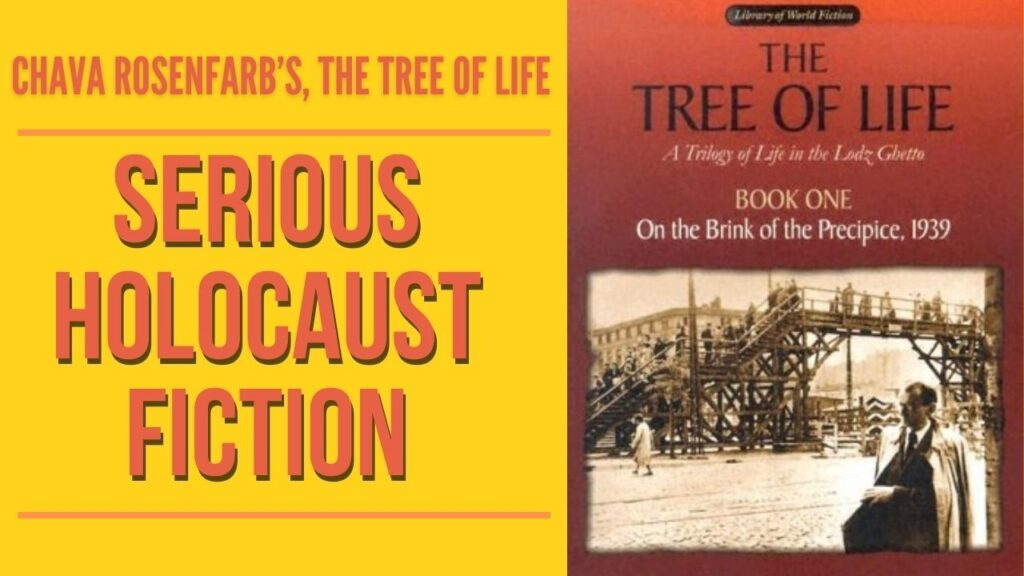
Our webinar with Goldie Morgentaler will discuss her mother Chava Rosenfarb’s Yiddish novel of Lodz, Poland January 1939 until the end of Lodz Ghetto in 1944. Dr. Morgentaler translated the book from Yiddish to English. Now there is an excellent Polish translation by Dr. Joanna Lisek . But this towering volume is virtually orphaned of a reading public. Noted author Dara Horn wrote: To call [The Tree of Life] a masterpiece would be an understatement. It is the sort of work—long, immersive, engrossing, exquisite—that feels less like reading a book than living a life.
Extensive references to the Tree of Life can be found at Yidlit, October 30, 2021 and at Yidlit February 22, 2022 and Yidlit April 23, 2022.

READ THIS BLOG POST HERE
THIS VIDEO WILL BE AVAILABLE PENDING NEW EDITS
WATCH THE VIDEO IN POLISH HERE
Karen Goodman will introduce a folkloric trope of Ashkenazic dance through the work of four artists: S. An-sky, Nathan Vizonsky, Judith Berg and Benjamin Zemach.
S. An-sky wrote the 1915 play, The Dybbuk or Between Two Worlds, which was based on his ethnographic research between 1912-14 amongst rural Jews in what is now Ukraine.
Lodz-born and raised Nathan Vizonsky came to the U.S. in 1920 and became an early figure in American Jewish folk and modern dance. He wrote the 1942 book Ten Jewish Folk Dances. Warsaw-born Judith Berg choreographed the 1937 film, The Dybbuk. Bialystok-born Benjamin Zemach was in the original Habima production of An-sky’s play in 1922.
CONTINUE READING
READ THIS BLOG POST HERE
WATCH THIS WEBINAR HERE
WATCH THE VIDEO IN POLISH HERE
10-23-22 – Three noted academics will address the challenges shaping Ukraine today. The bravery of the Ukrainian people is inspirational. What has created the remarkable resistance and cohesion the world has witnessed? Odesa-based academic Oksana Dovgopolova, as well as two of her Canadian colleagues, Aaron Erlich and Matthew Light, have studied the contemporary cultural and political landscape of Ukraine. Each panelist will focus on their area of research, and there will be a period for questions.
Excavating a Jewish Identity in Poland and Belarus with author Kathleen A. Balgley
READ THIS BLOG POST HERE
WATCH THIS WEBINAR HERE
WATCH THE VIDEO IN POLISH HERE
September 18, 2022 – Join Kathleen A. Balgley in a discussion of just released Letters to My Father: Excavating a Jewish Identity in Poland and Belarus. Kathleen Balgley’s memoir begins with her childhood discovery of her father’s hidden Jewish identity. Seeking to learn more about her own suppressed Jewishness, she immerses herself in the historically terrorized heart of wartime Europe and the epicenter of Jewish suffering by accepting a Fulbright to communist Poland just before the fall of the Berlin Wall. Balgley visits the archives of her father’s birthplace formerly in Poland (Brzesc), now Brest, Belarus and discovers the lives (and deaths) of her relatives. Throughout the journey, bashert (the Yiddish term for “destiny”) uncannily guides her to uncover deeply hidden stories. Her father, who had said he would not travel to Poland to visit, changes his mind after reading letters from his daughter. Touring the country together, father and daughter heal the rift between them.
In conversation, Neal Brostoff with Josh Horowitz and Cookie Segestein will introduce us to the hot-button issues in performing Jewish music/Jewish culture in Poland.
READ THIS BLOG POST HERE
WATCH THIS WEBINAR HERE
WATCH THE VIDEO IN POLISH HERE
Josh Horowitz and Cookie Segelstein, two of the three members of the band, performing violin and accordion music from their Polish klezmer CD. Brostoff will discuss with them unique features of Polish klezmer music. Veretski Pass has performed throughout Poland frequently.
CONTINUE READING
Ukrainian Refugee Relief and Beit Polska Redevelopment
READ THIS BLOG POST HERE
WATCH THIS WEBINAR HERE
WATCH THE VIDEO IN POLISH (translation pending)
The women and children who fled to Poland after Russia attacked Ukraine on February 24, 2022, were traumatized, hungry, and without shelter. Your compassionate response allowed Beit Polska/Friends of Jewish Renewal in Poland to assume a significant leadership role in addressing their immediate needs. We are reporting about those efforts. You gave us the tools to respond.
We joined you in leading with our hearts to address the immediate need. We are writing to thank you for your response and introduce ourselves more properly. Our current groundwork undertakings are to rebuild Progressive Jewish life in Poland. Our situation has been severely strained by the pandemic-related financial crisis and further exacerbated as we reach out to the Ukrainian war refugees in their hour of need.
Conscious History: Polish Jewish Historians before the HolocausT
Featuring Natalia Aleksiun
READ THIS BLOG POST HERE
WATCH THE VIDEO IN POLISH HERE
Conscious History: Polish Jewish Historians before the Holocaust is a historical triumph focused on the Polish Jewish ethos that developed in post-World War I, newly independent Poland. The emergence of the historian as a public intellectual, academic expert, and community leader is an inspiring saga. Opposition to Jews in Poland included mild forms of suspicion and increasingly new forms of antisemitism that were racial. Poland’s commitments under the League of Nations charters and in important sectors of its political spheres allowed Poland’s intellectuals to argue for a multi-national Poland. Polish Jewish historians argued for the rightful place of Jews in Poland’s history. Poland emerged after over a hundred years of domination by three different empires – Austro-Hungarian, Russian and Prussian. There was no unified Jewish intellectual tradition because many leaders wrote not only in Polish, Yiddish, and Hebrew but also in Russian and German. The emerging historians’ multiple tasks sought to bolster Jewish identity, fight the tide of antisemitism, and imagine a future intertwined in multidimensional and overlapping polities. These historians imagined Jews could be part of Poland in various ways, first and foremost by attaching to the Polish language and culture in multiple degrees. Others argued for Yiddish cultural ties and socialist economic commitments. Except for Emanuel Ringleblum, these historians are unfortunately unknown to most of us today. Through this presentation, Dr. Aleksiun will give us a glimpse of their various contributions. We learn that the first generation were exclusively men: Marceli Handelsman, Majer Balaban, Mojzesz Schorr, Filip Friedman, and Raphael Mahler.
Polish Jewish Art Music
READ THIS BLOG POST HERE
WATCH THIS WEBINAR HERE
WATCH THE VIDEO IN POLISH HERE
04-10-22 – Klezmer music has dominated the conversations about the post-communist Jewish culture renaissance in Poland.
However, creative activity in art music (classical music) has its own proud history, beginning with the virtuoso pianist and composer Maria Szymanowska in the late 18th century We will listen to one of her nocturnes, which strongly influenced Frederic Chopin’s compositional style. The webinar will offer an overview of primarily 20th century music of the Polish-Jewish experience, including the work of Krzysztof Penderecki (not Jewish) whose powerful Kaddish Oratorio concludes with the version of the Kaddish prayer sung at the High Holydays morning services. Szymon Laks survived Auschwitz, where he conducted the inmates’ orchestra. We will learn about his haunting art song on the poem of Antoni Slonimski, Elegy for the Lost Jewish Villages.
Survival On the Margins
READ THIS BLOG POST HERE
WATCH THIS WEBINAR HERE
WATCH THE VIDEO IN POLISH HERE
3-20-22 – The implementation of the August 1939 accord between Germany and the Soviet Union (Molotov-Ribbentrop) erased Poland. The Jews in the Soviet controlled sector of the former Poland, many of whom fled eastward or were deported by Soviet authorities or simply exiled to vast howling regions found a paradoxical refuge. They were at a far remove from unfolding persecutions and murders the Germans planed. The narrative about the fate of the 200,000 Polish Jewish refugees in the Soviet Union remained peripheral to the study of the Holocaust for over 75 years. Dr. Adler’s ground breaking work has opened up these areas of study for the English speaking audiences.
Featuring Lukasz Krzyzanowsi
READ THIS BLOG POST HERE
WATCH THIS WEBINAR HERE
WATCH THE VIDEO IN POLISH HERE
The poignant story of Holocaust survivors who returned to their hometown in Poland and tried to pick up the pieces of a shattered world.
In the immediate aftermath of World War II, the lives of Polish Jews were marked by violence and emigration. But some of those who had survived the Nazi genocide returned to their hometowns and tried to start their lives anew. Lukasz Krzyzanowski recounts the story of this largely forgotten group of Holocaust survivors. Focusing on Radom, an industrial city about sixty miles south of Warsaw, he tells the story of what happened throughout provincial Poland as returnees faced new struggles along with massive political, social, and legal change.
The Cultural Transfer of Psychoanalysis to the Polish Intelligentsia before WWII
READ THIS BLOG POST HERE
WATCH THIS WEBINAR HERE
WATCH THE VIDEO IN POLISH HERE
Dr. Lena Magnone, a specialist in the history of psychoanalysis and its influence on Polish culture, completed her habilitation five years ago. We will glimpse some aspects of this 1100 page magnum opus, which is currently being translated into English by Dr. Tul’si Bhambry. Freud’s Emissaries discuss the life trajectories of Polish Jews, rebellious men and women who joined Sigmund Freud at the earliest stage of the psychoanalytical movement formation and their efforts to implant psychoanalysis in educated Polish circles before World War II.
The Curious Story of Polish-Yiddish Tangos
READ THIS BLOG POST HERE
WATCH THIS WEBINAR HERE
WATCH THE VIDEO IN POLISH HERE
11-28-21 – The beguiling Argentinian tango zigzagged to Paris, Eastern Europe (especially Poland), then to America. Along the way, it picked up a musical doppelgänger – Yiddish tangos. The Jewish contribution to popular music and tangos in Poland is a significant piece in understanding the symbiosis of Polish and Jewish musical culture through the 1930s. “The Curious Story of Polish-Yiddish Tangos” will investigate that story with an illustrated lecture.
The program’s presenter, Neal Brostoff, taught courses in Jewish and Israeli music history and Jewish music performance in UCLA’s Departments of Ethnomusicology and Musicology from 2011 to 2016. Mr. Brostoff has also served as the music programs coordinator for the Mickey Katz Endowed Chair in Jewish Music at UCLA. He has taught Jewish music courses at Loyola Marymount University and at American Jewish University in Los Angeles. In his professional career, Mr. Brostoff has produced Jewish music concerts and festivals and has lectured on Jewish music topics. He has also served as director of …
The Honey and The Sting
Author Rabbi Walter Rothschild and Guests
READ THIS BLOG POST HERE
WATCH THIS WEBINAR HERE
WATCH THE VIDEO IN POLISH HERE
A comprehensive introduction to Judaism in Polish…is there a need? The Honey and the Sting is now published in Polish. This project is an opening to people curious about modern Judaism both its merits and its struggles. The opportunity for an international connection of people studying Judaism – many for the purpose of joining the Jewish people – allows for people to connect in a common purpose of sharing their Jewish learning experience. The title of the book comes from an Israeli song by the same name. The song, by Israeli composer and singer Naomi Shemer, refers to the fact that so many subjects have both a sweet and a bitter side. And yet she prays, “al kol eyle,” it all belongs together. Both the honey and the sting come from the same creature. Both the sweeter and the bitter parts of the Jewish experience come from the same Creator. The intention – which has been borne out by those who have read the English and the German versions – is that a person who reads and learns from this book in Polish will also acquire this more balanced perspective, not naively optimistic, not depressively pessimistic, but with a touch of both.
History on Trial & Historians Tested – Can Governments Re-write History?
READ THIS BLOG POST HERE
WATCH THIS WEBINAR HERE
WATCH THE VIDEO IN POLISH (translation pending)
A key aspect of Jan Grabowski’s work focuses on the fate of Jews (circa 1943-44) attempting to elude the Germans. The Russian westward advance against the Germans was a looming force. The German’s dissolution of the large ghettoes and forced labor camps was beginning. Many Jews sought to hide in forests or with farmers. Jews struggled to survive. Grabowski asks what was the role of local Polish mayors, fire departments, vigilante bounty hunters, and the Blue Police (Granatowa policja)? How did Polish society especially in the country-side view what was happening to their Jewish fellow citizens? In the magisterial 1700 page study “Night Without End: The Fate of Jews in Selected Counties of Occupied Poland” Jan Grabowski and Barbara Engelking with other Polish historians report on this question. Their micro-history has been acclaimed. Upon the book’s publication, Jan Grabowski and Barbara Engelking were sued in Polish court for defaming an individual mayor. Dr. Grabowski will talk about the book and the trial.
CONTINUE READING
READ THIS BLOG POST HERE
WATCH THIS WEBINAR HERE
WATCH THE VIDEO IN POLISH HERE
09-19-21 – Joanna Beata Michlic is a social and cultural historian, and founder and first Director of HBI (Hadassah-Brandeis Institute) Project on Families, Children, and the Holocaust at Brandeis University. She is an Honorary Senior Research Associate at the UCL Centre for the Study of Collective Violence, the Holocaust and Genocide, UCL Institute for Advances Studies, and an Honorary Senior Associate at the School of Slavonic and East European Studies (SSEES) in London. Her research focuses on social and cultural history of Poland and East European Jews, the Holocaust and its memory in Europe, East European Jewish childhood, rescue and rescuers of Jews in East Central Europe and antisemitism, racism and nationalism in Europe.
POSTPONED DUE TO ILLNESS
We will pray for his recovery.
Dr. Michael Steinlauf will discuss his two books:
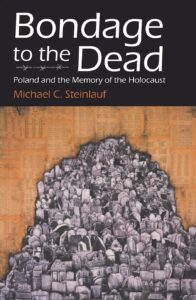
Bondage to the Dead: Poland and the Memory of the Holocaust
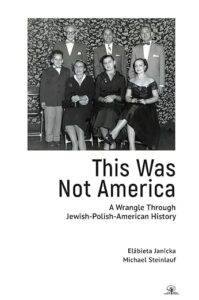
This Was Not America: A Wrangle Through Jewish-Polish-American History
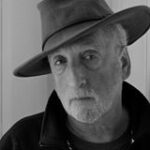 Michael Steinlauf’s scholarship has framed the issues of memory for Jews descended from survivors who retained a connection to the culture of Poland. Steinlauf’s rich historical and emotional memories are spread out in moving detail. For many years, before the travel to Poland fads, Steinlauf’s work was the single reliable perspective. The impact of Bondage to the Dead (1997) was not only on English readers but on Polish readers as well. Beginning in 2014, Elzbieta Janicka initiated with Steinlauf a “river interview” that saw its English debut in 2022. Polish scholar Janicka and Steinlauf engaged in lengthy conversations spanning the years and changing political and cultural situations entitled, This Was Not America: A Wrangle Through Jewish-Polish-American History. These two books will make up the basis of a conversation that will feature Professor Steinlauf in conversation with Rabbi Haim Beliak and Dr. David Kader.
BUY THE BOOK: BONDAGE TO THE DEAD HERE
BUY THE BOOK: THIS WAS NOT AMERICA HERE
ALL FREIGHTED LEGACIES BLOG POSTS
DONATE TO SUSTAIN THE FREIGHTED LEGACIES SERIES
A FULL LIST OF FREIGHTED LEGACIES EVENTS ARE HERE
DONATE TO OUR GENERAL FUND HERE
SUBSCRIBE TO OUR YOUTUBE CHANNEL